Reading the Signals — SIBO Symptoms in Detail
If you've been living with SIBO for a while, you already know bloating isn't the whole story — it's just the loudest part. Small intestinal bacterial overgrowth doesn't stay contained to the gut.
Reading the Signals — SIBO Symptoms in Detail
Bloating is the headline, but the story runs deeper. A quiet catalogue of how SIBO shows itself.
If you've been living with SIBO for a while, you already know bloating isn't the whole story — it's just the loudest part. Small intestinal bacterial overgrowth doesn't stay contained to the gut. Left unmanaged over months or years, it can quietly interfere with how your body absorbs nutrients, and that shows up in places you might never think to connect back to digestion. This is a catalogue of both: the symptoms everyone recognizes, and the ones that usually get chased down as separate, unrelated problems.
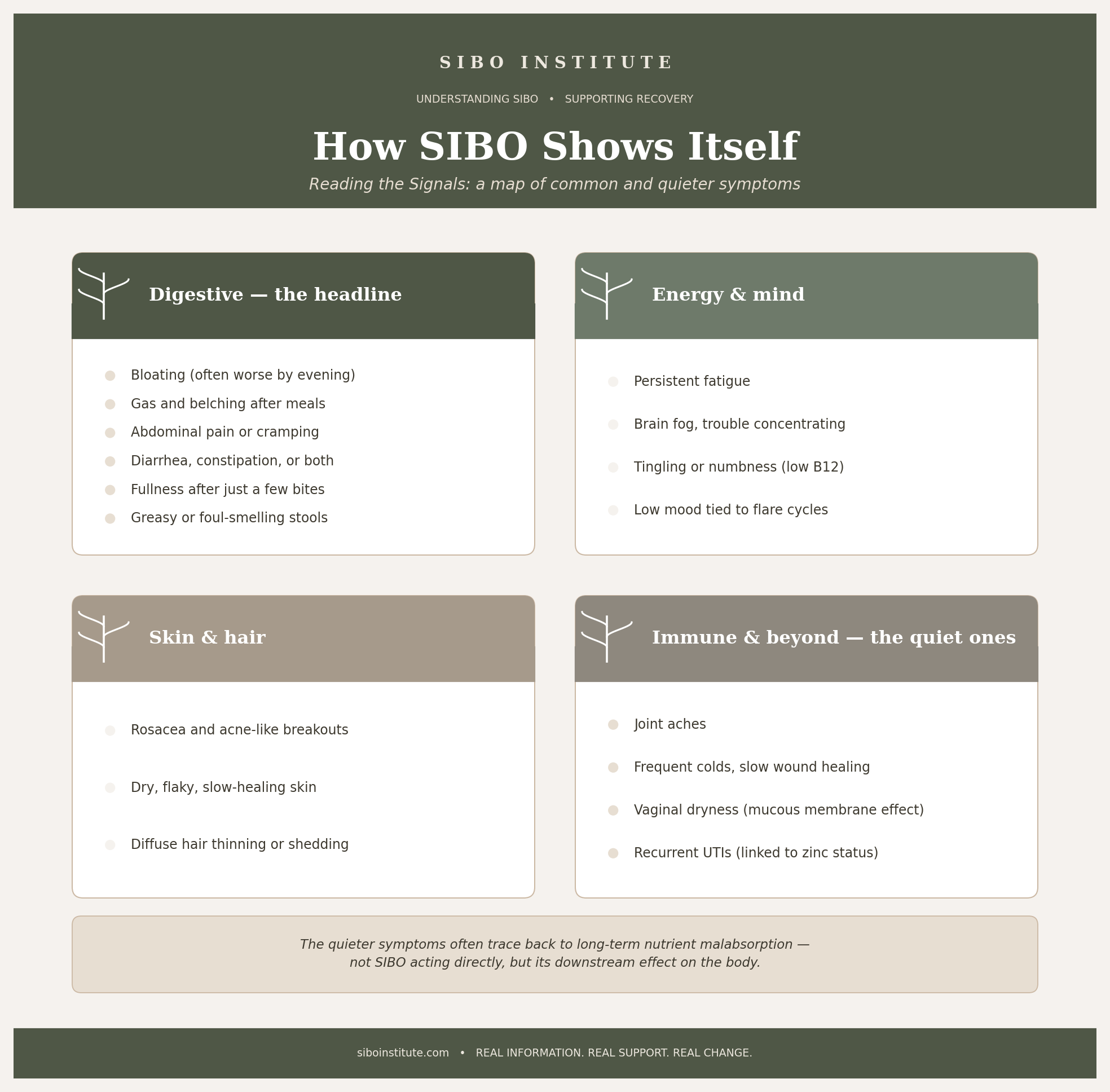
The Headline: Digestive Symptoms
These are the ones that usually send someone looking for answers in the first place.
- Bloating and visible distension, often worse as the day goes on
- Excessive gas and belching, frequently within 30–60 minutes of eating as bacteria ferment food in the small intestine
- Abdominal pain or cramping
- Diarrhea, constipation, or both, alternating
- A feeling of fullness after only a few bites
- Greasy, foul-smelling, or floating stools — a sign that fat isn't being broken down and absorbed properly
SIBO overlaps so heavily with IBS and food intolerance symptoms that it often goes undiagnosed for years. If this list sounds familiar, that overlap is exactly why.
The Quieter Signals
This is the part that surprises people. When bacterial overgrowth persists, it competes with your body for nutrients and interferes with the small intestine's ability to absorb what's left. Over time, that shows up as symptoms that don't look like a digestive issue at all.
Energy & Mind
Fatigue and brain fog. Overgrown bacteria consume vitamin B12 before your body has a chance to. Low B12 shows up as persistent tiredness, difficulty concentrating, and sometimes tingling or numbness in the hands or feet.
Low mood tied to flare cycles. Not talked about often, but a common thread — the exhaustion of managing unpredictable symptoms takes a real toll on its own.
Skin & Hair
Hair thinning or shedding. Hair follicles are nutrient-hungry tissue, and they're often one of the first places the body deprioritizes when nutrients run short. Low iron, B12, biotin, or zinc — all commonly depleted with long-term SIBO — can trigger telogen effluvium, a diffuse shedding that shows up months after the deficiency actually started, which is part of why the connection gets missed.
Skin changes — rashes, dryness, acne, and rosacea. This is actually one of the better-studied connections. Research has found people with rosacea are significantly more likely to have SIBO than the general population, with some studies putting SIBO prevalence in rosacea patients as high as 46–66%. In at least two studies, treating the SIBO led to measurable improvement in skin symptoms.
The mechanism runs through the gut-skin axis — inflammation and bacterial byproducts from the small intestine triggering an inflammatory skin response — alongside straightforward nutrient shortfalls. Low fat-soluble vitamins (A, D, E, K) are separately linked to dry, flaky skin and a slower healing response.
Immune & Beyond — The Ones Worth Mentioning Carefully
Joint aches. Less discussed, but a recurring complaint in people with long-standing SIBO, likely tied to the same systemic inflammation driving skin symptoms.
Frequent colds or slow healing. Zinc is absorbed primarily in the small intestine and plays a direct role in immune function and tissue repair. Chronic malabsorption can leave zinc levels low enough to blunt both.
Vaginal dryness and recurrent UTIs. These come up often enough in SIBO communities to be worth naming directly — but it's important to be honest about the evidence here, because this is where things get more speculative. There isn't research directly linking SIBO to either symptom. What does exist is a plausible chain of smaller, better-established connections: vitamin A is essential for maintaining healthy mucous membranes throughout the body, including the vaginal lining, so a fat-soluble vitamin deficiency from long-term malabsorption is a biologically reasonable contributor to dryness. Separately, zinc deficiency has a real, documented association with increased UTI risk through its role in immune defense. The honest version of this connection: it likely isn't SIBO itself causing these symptoms directly, but the downstream nutrient depletion and inflammation it can cause over time.
Why This Matters
None of this is meant to turn every symptom in your life into a SIBO symptom — that's its own kind of unhelpful spiral. But if you've been treating hair thinning, skin flare-ups, fatigue, or recurrent infections as separate from your digestive issues, it may be worth mentioning the fuller picture to your provider, especially if basic bloodwork (B12, iron, zinc, vitamin D) hasn't been checked recently.
A single bad skin week or one round of fatigue doesn't tell you much on its own — but a pattern, logged consistently over weeks, can reveal connections that are easy to miss day to day.
This article is for general educational purposes and isn't a substitute for medical advice or diagnosis. If you're experiencing persistent or worsening symptoms, talk to your healthcare provider — bloodwork can confirm a nutrient deficiency far more reliably than symptoms alone.